Symbolism & Feng Shui: The Meaning Behind Money Trees
Explore the rich cultural significance of the Money Tree in Chinese tradition and Feng Shui — how its braided trunk, five-leaf clusters, and placement in the home are believed to attract wealth, harmony, and positive energy.
The Money Tree (Pachira aquatica) is far more than a handsome houseplant — it carries centuries of cultural weight, spiritual meaning, and intentional symbolism that has made it one of the most gifted and cherished plants across East Asia and beyond. Whether you received yours as a housewarming present, bought it for your office, or simply fell in love with its braided trunk and glossy leaves, understanding the lore behind the plant transforms how you relate to it. From a humble Taiwanese truck driver’s experiment in the 1980s to a fixture in feng shui practice worldwide, the Money Tree’s story is as layered as its carefully woven stems.
Origins of the Money Tree’s Symbolism #
The modern legend of the braided Money Tree traces back to Taiwan, China (hereinafter referred to as Taiwan) in the 1980s. A truck driver — facing financial hardship — discovered a small Pachira aquatica growing in his field and, inspired, began cultivating and braiding multiple seedlings together into a single plant. He sold the braided plants and found remarkable commercial success. Word spread quickly, and the practice of braiding young Pachira trunks became widespread across Taiwan and, soon after, throughout East Asia. The plant became synonymous with financial good fortune, and its reputation crossed borders as the global houseplant trade expanded.
Long before this modern chapter, Pachira aquatica held significance in Chinese cultural traditions as a tree associated with abundance and prosperity. Its large, palmate leaves — spreading outward like an open hand ready to receive blessings — were seen as a natural emblem of generosity and good fortune. The combination of ancient symbolism and the truck driver’s success story cemented its status as the definitive “luck plant” for home and business.
The Five-Leaf Cluster and the Five Elements #
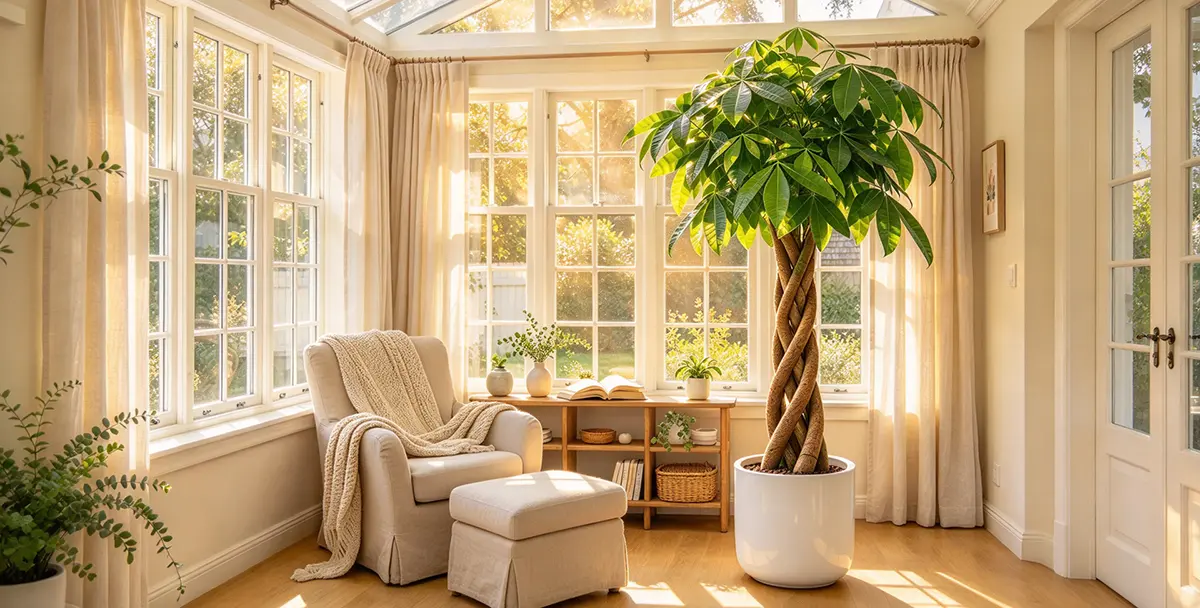
Most healthy Money Trees produce leaf clusters with exactly five leaflets — a number considered deeply auspicious in Chinese philosophy and feng shui practice.
The five-leaflet arrangement on each stem is no coincidence in its symbolic reading. In traditional Chinese cosmology, the number five corresponds to the Wu Xing — the five fundamental elements that govern all natural phenomena:
- Wood — growth, vitality, and upward momentum.
- Water — flow, intuition, and abundance.
- Fire — passion, transformation, and energy.
- Earth — stability, nourishment, and grounding.
- Metal — clarity, precision, and financial strength.
When you place a Money Tree in your home, you are — symbolically — inviting the balance of all five elements into your space simultaneously. Occasionally, Money Trees produce leaves with six or seven leaflets; in Chinese tradition, a seven-leaflet leaf is considered extraordinarily lucky and is treated almost like finding a four-leaf clover.
If your Money Tree puts out a leaf with seven leaflets, don’t pluck it. Display it prominently or press and frame it — it’s considered a powerful token of incoming good fortune.
The Braided Trunk: Weaving in Good Fortune #
The braided trunk that defines most commercially sold Money Tree varieties is both a horticultural technique and a spiritual metaphor. Growers braid three, five, or seven young seedlings together while their trunks are still pliable, then allow them to fuse and thicken over time into a single, intertwined structure. Note that trunks are never braided in even numbers — even numbers are considered inauspicious in this context.
Symbolically, the braided trunk is said to trap good luck within its weave, preventing fortune from escaping the household. The intertwining of multiple individual plants into one unified form also represents unity, partnership, and the collective strength of family or business relationships. For entrepreneurs and business owners, this makes the braided Money Tree a particularly meaningful talisman — a visible reminder that collaboration and interconnection are the roots of lasting prosperity.
Feng Shui Principles: Attracting Wealth and Positive Chi #
In feng shui — the ancient Chinese practice of harmonizing individuals with their surrounding environment — the Money Tree is classified as a wood-element plant that activates and amplifies sheng chi (the energy of growth and vitality). Its upward-reaching branches and lush canopy are seen as conduits for positive energy flow, while its rounded leaf shape is considered auspicious — sharp, pointed leaves are thought to create “poison arrows” of negative energy in feng shui.
- Attracting Wealth — activating the prosperity corner of a home or room.
- Inviting Good Luck — greeting incoming energy at entrances and new beginnings.
- Promoting Harmony — balancing stagnant or tense spaces with the wood element.
The Money Tree is most commonly used to activate the wealth and prosperity corner of a home or room. Placing it in the southeast sector — which governs abundance in the Bagua energy map — is believed to stimulate financial growth and open new income opportunities. Pairing it with other wealth symbols (a small water feature, gold coins, or citrine crystals placed near the base) is thought to amplify its effect.
Beyond wealth, the Money Tree is associated with overall good fortune and positive beginnings. Positioning it near the main entrance of a home or business allows it to greet incoming energy, infusing new opportunities and visitors with auspicious chi before they even step fully inside. Many feng shui practitioners recommend placing a Money Tree in newly established businesses or homes to “set the tone” for prosperity from day one.
As a balanced embodiment of all five elements, the Money Tree is also used to harmonize spaces that feel energetically stagnant or tense. In a home office, it softens the hard lines of technology and furniture. In a living room, it introduces the wood element’s natural vitality to spaces dominated by metal (electronics) or earth (heavy furniture). Its calming green presence is thought to reduce stress and promote clear, focused thinking.
Ideal Placement Locations #
Where you position your Money Tree matters both energetically and practically — fortunately, feng shui recommendations and good horticultural sense often align.
- The Southeast Corner (Wealth Corner). The southeast sector of your home or any individual room corresponds to the Xun area of the Bagua — the zone governing wealth, abundance, and self-worth. This is the single most recommended feng shui placement. Make sure the area receives adequate indirect light so the plant can thrive; a healthy, vibrant plant generates far more positive energy than a struggling one.
- Near the Main Entrance. Position your Money Tree close to — but not directly blocking — your front door. This placement greets incoming energy and visitors with prosperity symbolism, and ensures the plant benefits from the consistent airflow and activity of a well-used entryway. Avoid placing it so close that people brush against it when entering, as this can damage the branches and is considered disruptive to chi flow.
- On Your Office Desk or Workspace. A smaller or dwarf Money Tree on your desk is one of the most popular placements for professionals and entrepreneurs. It keeps prosperity symbolism literally within arm’s reach during your working hours and is believed to support financial decision-making and career growth. Position it to the left of your monitor (your “wealth side” in many feng shui traditions) for best effect.
- The Living Room. A well-lit corner of your living room — particularly the southeast corner — makes an excellent home for a larger Money Tree. The living room is considered the heart of the home in feng shui, and a thriving plant here broadcasts its positive energy throughout the entire household. Ensure it has enough space to grow without its canopy being compressed by furniture or low ceilings.
What to Avoid: Placement Pitfalls #
Placing your Money Tree in an energetically or physically unsuitable location can negate its positive symbolism — and will almost certainly harm the plant itself.
- Bathrooms. Bathrooms are considered inauspicious in feng shui because water — symbolizing wealth — is constantly draining away. Placing a Money Tree near a toilet or in a bathroom is believed to symbolically “flush” your good fortune. Practically, the combination of poor light, humidity fluctuations, and temperature swings also makes bathrooms challenging environments for Pachira aquatica.
- Dark Corners. A Money Tree shoved into a dim corner will languish — and a struggling, yellowing plant is considered a very bad omen in feng shui, symbolizing declining fortunes. If your desired placement doesn’t receive sufficient natural light, supplement it with a full-spectrum grow light to keep the plant vibrant and the energy active.
- Near Sharp Corners or Pointed Objects. Feng shui warns against positioning any auspicious plant in the path of sha chi — negative energy created by sharp architectural corners, exposed beams, or pointed decorative objects aimed at the plant. If a wall corner or piece of furniture points directly at your Money Tree, reposition the plant or use another object to deflect the sharp energy before it reaches the tree.
- Directly on the Floor in High-Traffic Areas. While floor placement is fine for large plants in stable spots, avoid placing your Money Tree where it will be bumped, kicked, or its soil constantly disturbed. Unstable energy around the plant is thought to create instability in the areas of life it governs. Use a sturdy plant stand to elevate it if the floor-level spot is particularly busy.
- Near Air Conditioning Vents or Cold Drafts. Cold drafts stress the plant and cause leaf drop — symbolically, shedding leaves is never a welcome sign. Keep your Money Tree away from AC vents, drafty windows, and exterior doors that are frequently opened in cold weather.
Gifting Traditions #
The Money Tree is one of the most beloved and universally appropriate gifts in Chinese and Taiwanese tradition — and increasingly in Western culture as well. Its symbolism makes it suitable for virtually any positive life transition:
New Business Openings #
Gifting a braided Money Tree at a grand opening is a deeply ingrained tradition in Chinese business culture. It signals that the giver wishes the new venture financial success, longevity, and harmonious relationships with customers. Many Asian restaurants, salons, and shops display them prominently near their registers or entrances as permanent fixtures.
New Homes & Housewarmings #
A Money Tree given at a housewarming blesses the new space with prosperity and positive energy from its very first days of habitation. It’s a practical gift too — beautiful, long-lived, and relatively easy to care for — making it equally welcome among plant novices and enthusiasts.
Weddings & New Beginnings #
For newlyweds setting up a shared home, or for graduates beginning a new chapter, a Money Tree carries wishes for financial stability and a flourishing future. Pairing it with a handwritten note explaining its symbolism makes the gift even more meaningful and memorable.
When gifting a Money Tree, attach a small red ribbon or red envelope (a traditional symbol of luck and good wishes in Chinese culture) to the base of the trunk. Red activates the fire element and amplifies the plant’s auspicious energy — it’s a small touch that recipients who know the tradition will deeply appreciate.